
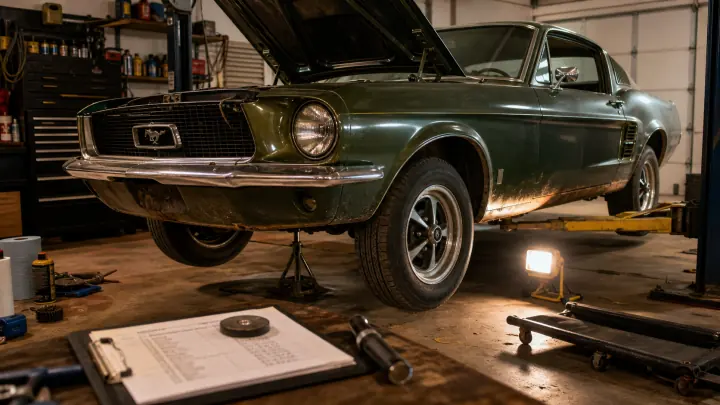
Before buying a 1967 Mustang, check the car’s identity, structure, and mechanical condition. Ask for documents and photographs first, then arrange an inspection of the actual car. A tidy interior and fresh paint leave many of the expensive questions unanswered.
Before you travel or leave a deposit
Ask for the identification details, current ownership documents, a description of known problems, and clear photographs of the underside and previous repairs. If a seller cannot answer something, record it as an open question. Ask whether an independent specialist may inspect the car.
For a 1967 Mustang, Ford lists body serial code 01 for hardtop, 02 for fastback, and 03 for convertible. These are distinct from the longer BODY code on the data plate. The licensed Ford manual sample, vehicle identification page 1-2, shows the distinction. A decoded entry does not establish the identity or history of the whole car.
1967 Mustang inspection checklist
- Identify the car. Compare the readable identification numbers and documents. Ask a knowledgeable inspector to investigate mismatches or signs of altered identification before you proceed. Record engine and transmission claims separately from what can be verified.
- See the metal. Have an experienced inspector examine the underside, structural members, and prior repairs. Ask for clear photos. New undercoating or trim may limit what can be seen; that means more inspection is needed.
- Check for water entry. Look for damp carpet, staining, musty smell, and corrosion. Ask the inspector to identify the source and extent. A wet footwell alone does not diagnose a cowl repair.
- Assess the mechanical systems. Have brakes, steering, tires, suspension, fuel system, wiring, and cooling evaluated before a road test. If safe to run, observe a cold start and hot restart with the inspector.
- Account for unfinished work. List missing trim, nonworking equipment, loose parts, and work the seller says is nearly complete. Get the important unknowns assessed and quoted.
Where to look for rust and old repairs
Use this as a route around the car with your inspector. It identifies areas to examine, not a way to certify structural condition from photographs.
| Area | What to include in the inspection |
|---|---|
| Front and cowl | Cowl, lower windshield corners, firewall, front floors, shock towers, aprons, and front rails. |
| Cabin and underside | Floors, seat platforms, rockers, torque boxes, structural joints, and previous patches. |
| Rear | Trunk floor, drop-offs, rear rails, wheelhouses, lower quarters, and glass channels. |
| Body-specific details | Fastback roof and rear-window areas; coupe rear-window area; convertible rockers, top well, top mechanism, and weather sealing. |
Photograph a wide view and a close-up of each concern. Do not scrape coatings, probe metal, remove trim, lift the car, or introduce water without the owner’s permission and an appropriate inspection procedure.
What should make you pause?
An identification mismatch, uncertain ownership documentation, structural damage, or a problem that makes the car unsafe needs resolving before purchase. A seller who refuses an independent inspection leaves you with information you cannot obtain. You can decide not to proceed.
Fresh paint, replacement panels, or a modified engine are not proof of a bad car. Ask who did the work, what was repaired, and which records or photographs support it. Make the decision on the findings.
What to bring
Bring the seller’s answers, a checklist, phone camera, notebook, and a light. Use what you already own. A specialist supplies the experience and any equipment needed for the agreed inspection.
If you need a light, automotive inspection lights · Amazon affiliate can help with clear photographs of dim areas. We may earn a commission at no extra cost to you. As an Amazon Associate I earn from qualifying purchases.
Compare the car and the work it needs
Choose recent completed sales with similar body style, equipment, condition, and documentation. Read what the listing actually says about repairs and included parts. Asking prices show what sellers want; they do not show what buyers paid.
Then add your transport, inspection, and quoted immediate work to the purchase price. Record unresolved costs as unknown. A low asking price does not answer an unpriced structural repair.
A useful question for two candidates
One car comes with photographs of a completed floor repair. The other has new carpet and no underside pictures. Ask the same inspector what evidence is still needed for each car. Do not assign the second car a lower repair budget just because nothing is visible in the listing.
This is an invented comparison to explain the process, not an appraisal or a claim about two real cars.
Sources and review notes
Sources and coverage
Page updated: September 7, 2026
Questions to take to a seller and an independent inspection.
- The checklist covers documents, visible rust, drivability, and the cost of known work. It cannot establish title status or the condition of hidden structure.
- Body-code descriptions are explained in the body-style reference. The guide does not provide a current market valuation.
References and related guides
Found an error? Send the page link and a source for the correction.